Goomeri War Memorial Clock


Statement of Significance

Goomeri War Memorial Clock is a place that satisfies one or more of the criteria specified in s.35(1) of the Queensland Heritage Act 1992 as evidenced by, but not exclusive to, the following statement of cultural heritage significance, based on criteria A, B, D, E and G.


image
criterion a 
the place is important in demonstrating the evolution or pattern of Queensland’s history


War Memorials are important in demonstrating the pattern of Queensland's history as they are representative of a recurrent theme that involved most communities throughout the state. They provide evidence of an era of widespread Australian patriotism and nationalism, particularly during and following the First World War.

It also has special association with Brisbane metalworker Ernest Gunderson as an example of his workmanship.


image
criterion b 
the place demonstrates rare, uncommon or endangered aspects of Queensland’s cultural heritage  
 

It is one of the few memorials in Queensland in the form of a clock tower and has uncommon decorative features.

image
criterion d 
the place is important in demonstrating the principal characteristics of a particular class of cultural places 
 

The Goomeri Hall of Memory demonstrates the principal characteristics of a building designed for the use, both recreational and administrative, of returned soldiers and their families, with its honour rolls, meeting rooms, supper room, and dance hall.  The large hall remains important in demonstrating the principal characteristics of its type, with a timber floor laid especially for dancing, a stage, supper room and large banks of windows to the street elevation.

image
criterion e 
the place is important in exhibiting particular aesthetic characteristics valued by the community or a particular cultural group 
 

The Hall of Memory has landmark qualities as a large and well-detailed building on a prominent elevated site and makes a major contribution to the character of the townscape of Goomeri.


image
criterion g 
the place has a strong or special association with a particular community or cultural group for social, cultural or spiritual reasons 


The Goomeri Hall of Memory has a spiritual and social association with the Returned Services League as both a war memorial and a meeting place.  It also has a special association with community of Goomeri and district because of its long use for many social functions, including balls, concerts and the showing of films.


image

Expressions of Interest

Gympie Regional Council welcome's expressions of Interest
for the inclusion of your place on the Gympie Region Heritage Trail.


History

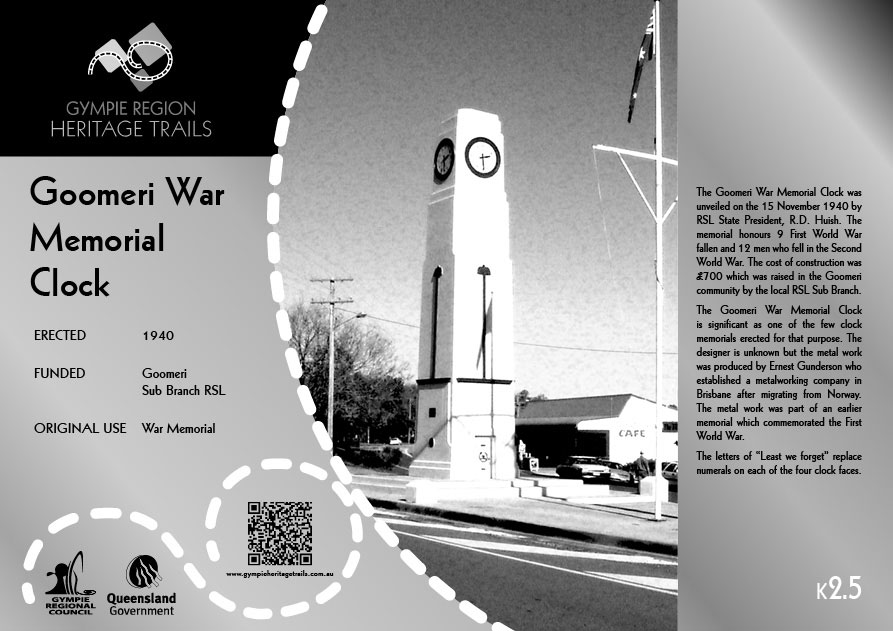
imageThe Goomeri War Memorial Clock was unveiled on 15 November 1940 by RSL State President RD Huish. The concrete memorial honours the 9 local men who fell in the First World War and the 12 who fell in the Second World War.

It was erected at a cost of £700 which was raised by the Goomeri Returned Services League Sub-Branch.

Australia, and Queensland in particular, had few civic monuments before the First World War. The memorials erected in its wake became our first national monuments, recording the devastating impact of the war on a young nation. Australia lost 60 000 from a population of about 4 million, representing one in five of those who served. No previous or subsequent war has made such an impact on the nation.

Even before the end of the war, memorials became a spontaneous and highly visible expression of national grief. To those who erected them, they were as sacred as grave sites, substitute graves for the Australians whose bodies lay in battlefield cemeteries in Europe and the Middle East. British policy decreed that the Empire war dead were to be buried where they fell. The word 'cenotaph', commonly applied to war memorials at the time, literally means 'empty tomb'.  

Australian war memorials are distinctive in that they commemorate not only the dead. Australians were proud that their first great national army, unlike other belligerent armies, was composed entirely of volunteers, men worthy of honour whether or not they paid the supreme sacrifice. Many memorials honour all who served from a locality, not just the dead, providing valuable evidence of community involvement in the war. Such evidence is not readily obtainable from military records, or from state or national listings, where names are categorised alphabetically or by military unit.  

imageAustralian war memorials are also valuable evidence of imperial and national loyalties, at the time, not seen as conflicting; the skills of local stonemasons, metalworkers and architects; and of popular taste. In Queensland, the soldier statue was the popular choice of memorial, whereas the obelisk predominated in the southern states, possibly a reflection of Queensland's larger working-class population and a lesser involvement of architects.

Many of the First World War monuments have been updated to record local involvement in later conflicts, and some have fallen victim to unsympathetic re-location and repair.

Although many different types of war memorials were erected throughout Queensland, the clock type of memorial was comparatively rare. It is not known who designed the memorial, however the metal work was produced by Ernest Gunderson and was originally part of an earlier monument which also commemorated the First World War.

Ernest Gunderson established his metalworking company in Brisbane after migrating from Norway. The company operated until the mid 1930s and supplied honour boards and plates for memorials statewide. His work was distinctly original, often incorporating both Australian and British motifs.

The monument is painted, with details now picked out in darker colours..  

Description  

imageThe First World War Memorial is situated in a traffic island in one of the main intersections of Goomeri. It is a dominant landscape feature from most locations in the town.

The traffic island is located in the centre of the intersection, level with the road on the eastern side and dropping away on the western side. A flagpole is located on the north side of the monument which sits on a stepped concrete pad with short square concrete bollards at each corner.

The painted concrete monument rises to a height of 74 feet and comprises a tapered tower with clockfaces at the apex. Fixed to the west face of the foundation and to the north face of the clocktower are metal components from Goomeri's former memorial to the First World War.

The tower is subtly divided into three sections; a base, the body and the clock.

The base has shallow simply moulded details around the base and at each corner and has applied moulding at the termination of the base section. A substantial metal door bearing a bronze Australian Coat of Arms surrounded by a laurel wreath is recessed into the north face. The dates 1914 and 1919 are located above and below the wreath, also in bronze.

On each of the other faces are polished granite plaques with the engraved names of those who made the Supreme Sacrifice. The southern face bears the names of the nine who fell in the First World War and the dates 1914 - 1919. The western face displays the names of the twelve who fell in the Second World War, and the eastern face is blank.

Above the base is the body of the tower which is plain except for a simple central decorative element, painted dark brown. The uppermost section of the body has stop-chamfers to each corner which continue into the clock section.

The clock itself is located at the top of the tower and comprises four faces which are illuminated at night. The letters Lest we forget (reading clockwise) replace the numerals on each clock face.


image

Expressions of Interest

Gympie Regional Council welcome's expressions of Interest
for the inclusion of your place on the Gympie Region Heritage Trail.


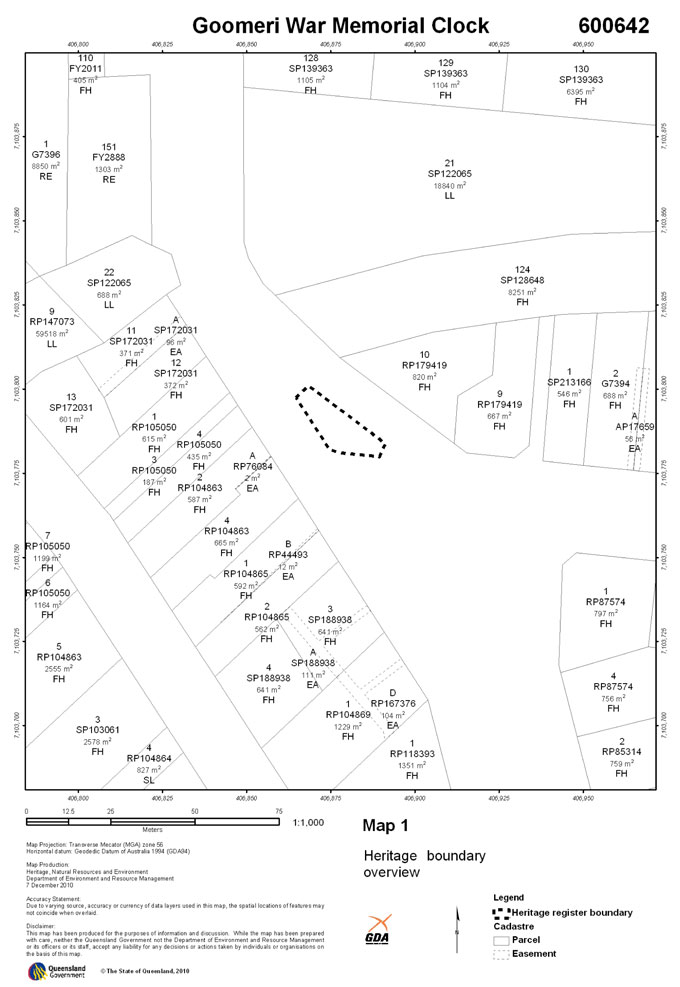
Heritage Listed Boundary

image

error
image

Gympie Region Heritage Trail website is packed full of interesting details about the Gympie, Mary Valley, Cooloola Coast, Goomeri & Kilkivan. Take a journey back in time and explore the Gympie Region rich history  which included gold mining, dairy, beef, timber, farming, rail & many more iconic attractions and events that shaped the region into what it is today!

imageimageimage

All content copyright © 2026 Gympie Regional Council, unless otherwise stated. For more information, copyright notice, disclaimer and privacy statement…